
Introduction
In the past, building applications for multiple platforms meant maintaining separate codebases for Android, iOS, web, and desktop. This approach was expensive, time-consuming, and often inconsistent.
Today, developers are moving toward unified development strategies—and one company leading this transformation is JetBrains.
Known for creating industry-standard tools like IntelliJ IDEA, JetBrains is now pushing boundaries with a modern approach to cross-platform development that prioritizes flexibility, performance, and developer experience.
The Evolution of Cross-Platform Development
Before diving into JetBrains’ impact, it’s important to understand how we got here.
Frameworks like React Native and Flutter introduced the idea of sharing code across platforms. While powerful, they often rely heavily on abstraction layers, which can sometimes limit performance or access to native features.
JetBrains takes a different approach, share what makes sense, and keep the rest native.
Kotlin Multiplatform: A Game Changer
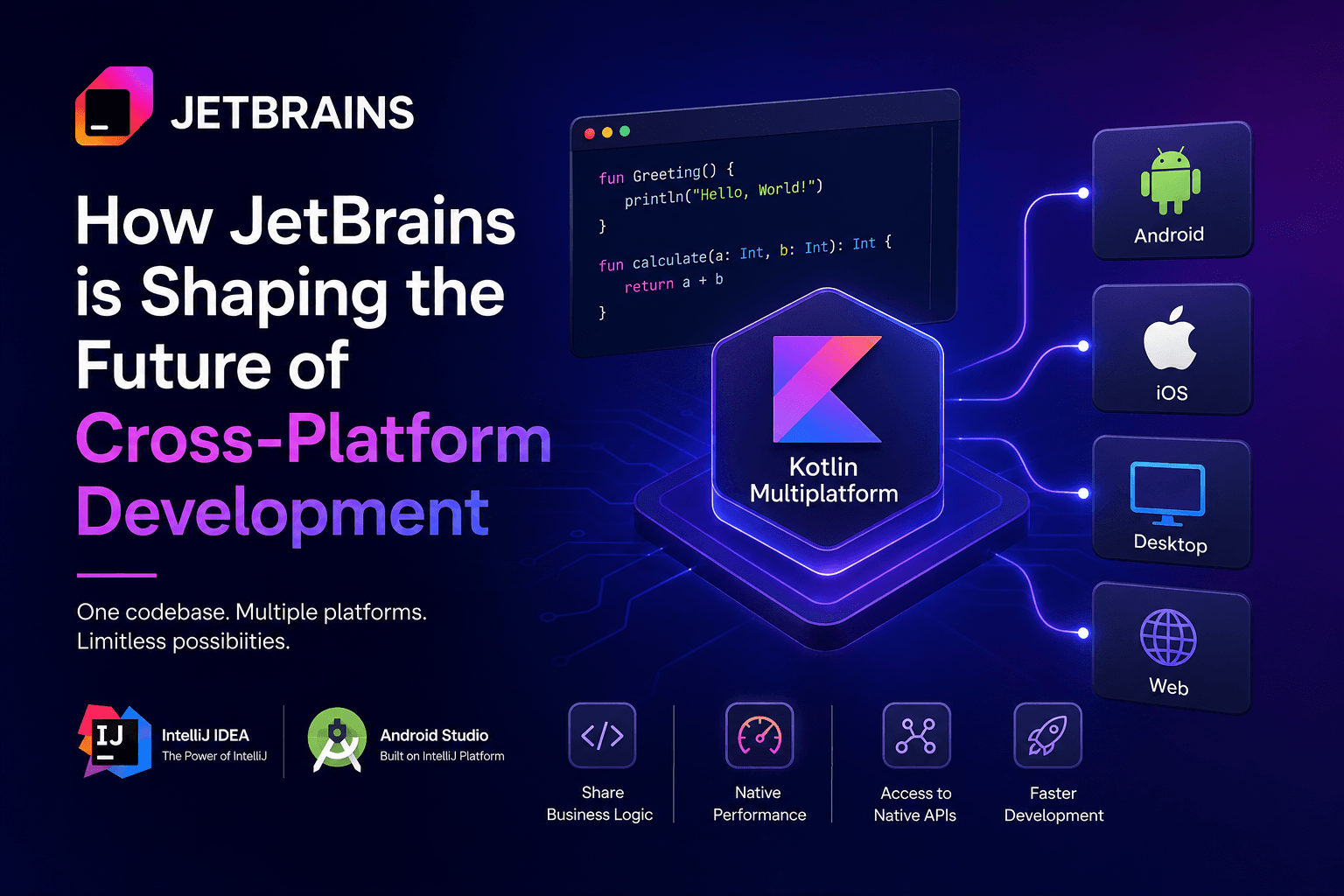
At the heart of JetBrains’ strategy is Kotlin Multiplatform (KMP).
Unlike traditional cross-platform tools, KMP allows developers to:
- Share business logic across platforms
- Keep platform-specific UI code
- Access native APIs without restrictions
This means you’re not forced into a one-size-fits-all solution.
Why This Matters
Performance remains native
Flexibility is preserved
Code duplication is reduced
Instead of replacing native development, KMP enhances it.
Compose Multiplatform: UI Without Limits
JetBrains didn’t stop at logic sharing. With Compose Multiplatform, they are extending the declarative UI paradigm across platforms.
Built on Jetpack Compose, Compose Multiplatform allows developers to:
Write UI once and reuse it across Android, desktop, and web
Maintain a consistent design system
Speed up UI development significantly
This is a major step toward full-stack Kotlin development.
The Power of the Kotlin Ecosystem
Everything JetBrains is building revolves around Kotlin.
Kotlin’s advantages include:
- Concise and readable syntax
- Strong type safety
- Full interoperability with Java
- Growing ecosystem across mobile, backend, and web
From Android apps to backend systems using Ktor, Kotlin is becoming a true multi-purpose language.
Developer Experience: JetBrains’ Secret Weapon
JetBrains has always been known for developer-first tools, and that hasn’t changed.
Tools like:
- IntelliJ IDEA
- Android Studio (built on IntelliJ)
…provide deep integration with Kotlin Multiplatform, making development smoother and more productive.
Features include:
- Smart code completion
- Built-in debugging tools
- Seamless project configuration
This tight ecosystem gives JetBrains a major advantage over competitors.
A Shift in Industry Thinking
JetBrains is not just building tools—they are influencing how developers think about cross-platform architecture.
Instead of asking:
> “How can I avoid writing native code?”
Developers now ask:
> “What should I share, and what should remain platform-specific?”
This shift leads to better apps and more maintainable codebases.
Challenges and Limitations
Despite its promise, JetBrains’ approach isn’t without challenges:
- Kotlin Multiplatform still has a learning curve
- Ecosystem maturity is growing but not yet as large as competitors
- Some tooling and libraries are still evolving
However, rapid adoption and continuous updates suggest these gaps won’t last long.
The Future of Cross-Platform Development
JetBrains is positioning itself as a leader in the next generation of development tools.
With ongoing improvements to:
- Kotlin Multiplatform
- Compose Multiplatform
…the future looks like:
- More shared logic across platforms
- Faster development cycles
- Better performance and user experience
And most importantly more control for developers.
Conclusion
JetBrains is not trying to replace native development—it’s making it smarter.
By focusing on flexibility, performance, and developer experience, JetBrains is shaping a future where cross-platform development is not a compromise, but an advantage.
If you’re a developer looking to build scalable, modern applications, now is the perfect time to explore what JetBrains has to offer.


