
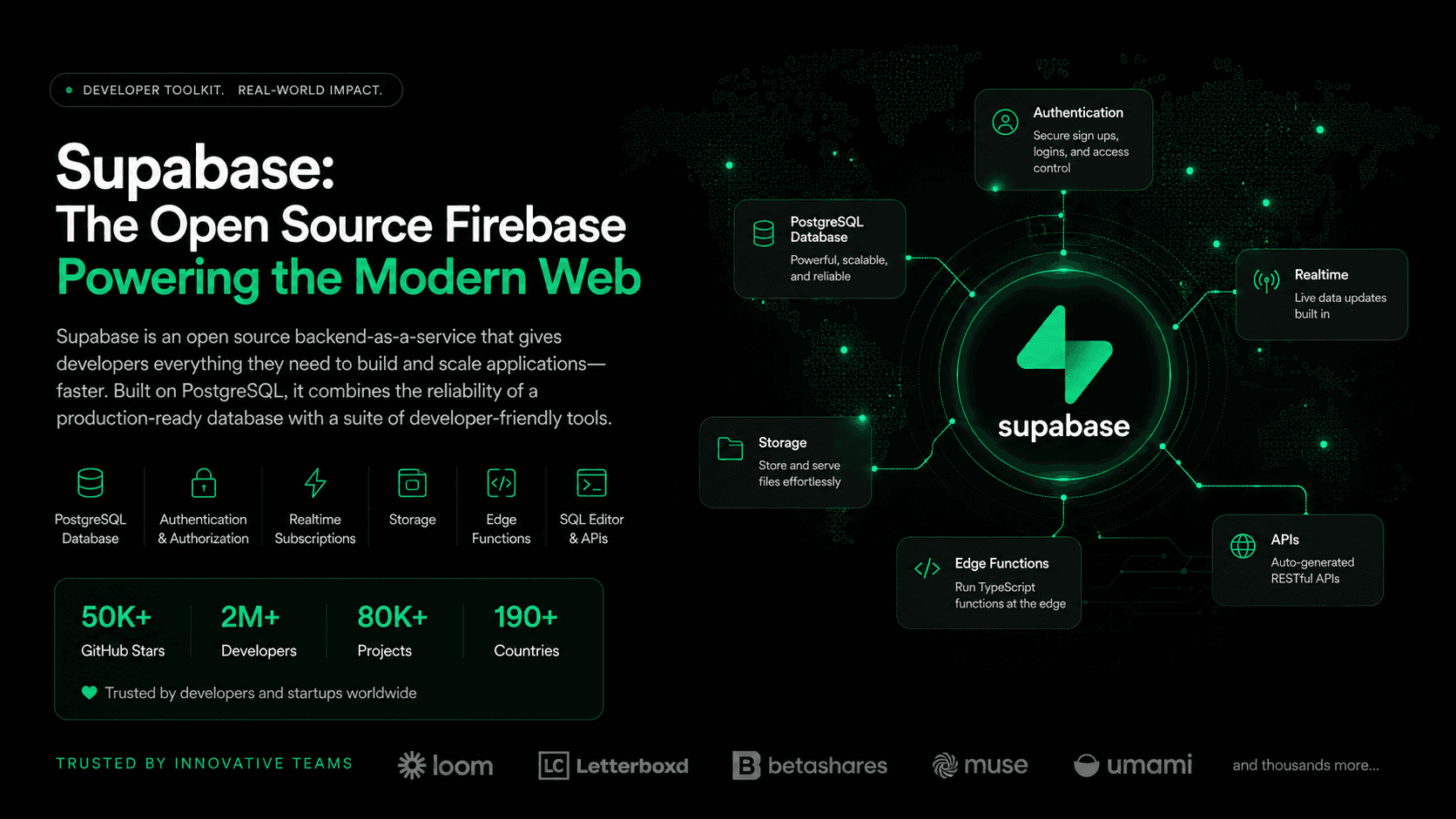
Why I Use Supabase as the Backbone of My Apps
When I build products, I care about one thing above everything else: moving fast without sacrificing control. Over time, I’ve tried different backend stacks—custom APIs, Firebase, self-hosted solutions—but I kept running into the same tradeoffs.
That’s where Supabase clicked for me.
From Idea to Production — Without the Usual Friction
In my workflow, I don’t want to spend days wiring basic infrastructure before I can even test an idea. With Supabase, I can go from:
database → API → authentication → realtime → storage
in a matter of minutes
What I like most is that nothing feels “black box.”
Everything is built on PostgreSQL, which means I can:
- write real SQL
- create functions and triggers
- optimize queries when needed
- and fully understand what’s happening under the hood
That’s a huge difference compared to many managed backends.
Fits Perfectly Into My Stack
Most of my work revolves around mobile and cross-platform apps—especially with Kotlin Multiplatform. Supabase integrates cleanly into that setup.
In practice, I use it for things like:
- Realtime data sync (e.g. trading data, live updates)
- Auth flows without building everything from scratch
- Structured data storage with relational logic
- Edge functions for backend logic when needed
It lets me keep my architecture clean without spinning up a full custom backend unless I truly need one.
Why I Chose It Over Alternatives
I’ve used other solutions, but Supabase hits a balance that’s hard to beat:
- Faster to iterate than custom backend
- More flexible than Firebase
- Open-source and self-hostable when needed
That last part matters a lot to me. I like knowing I can run the entire stack myself if I want full control—which I’ve actually experimented with.
Production-Ready, Not Just a Prototype Tool
A lot of tools are great for MVPs but fall apart at scale. Supabase doesn’t feel like that.
It’s already powering serious apps, and from my experience:
- performance is solid
- schema design scales well
- realtime features are reliable
- and the ecosystem keeps improving
I’ve used it in projects where data consistency and timing actually matter, and it holds up.
The Developer Experience Is the Real Win
At the end of the day, what keeps me using Supabase is simple:
it removes friction without taking away control
I can focus on building features, refining UX, and solving real problems—instead of maintaining backend plumbing.
Final Thoughts
Supabase isn’t just another backend tool in my stack—it’s become a default starting point for most of my projects.
If I need something quick, scalable, and flexible, I reach for it first.
And if the project grows beyond it?
I still have the freedom to evolve the architecture—without being locked in.


